

Culture
At Sisè, Familiar Clothes Take an Unexpected Shape
For Spring/Summer 2027, Tsitse Olugbemi’s EGBE URO explores how proportion, pattern and unexpected combinations can change familiar clothes.
by Amara Okafor
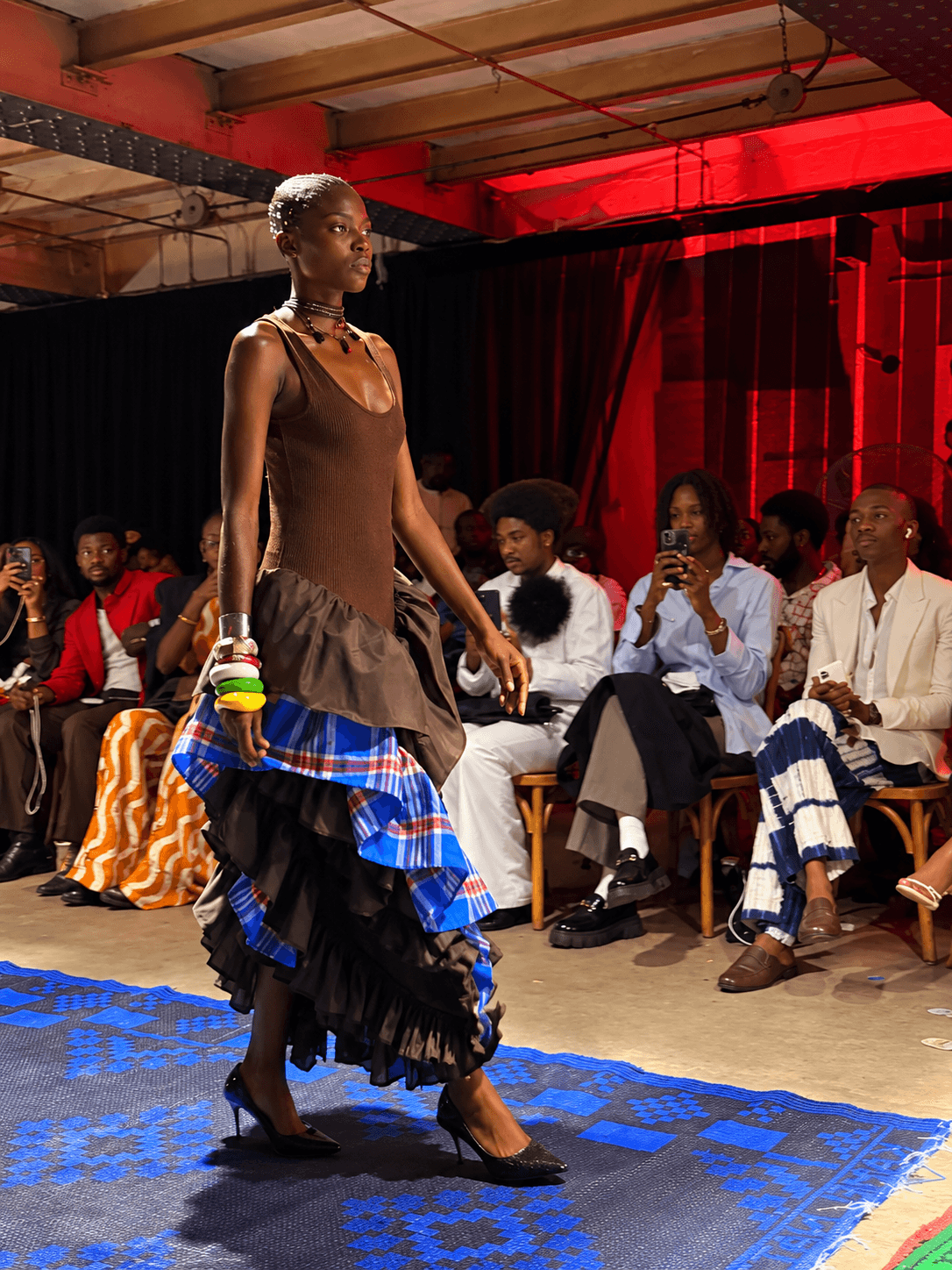
A long brown sleeveless top fell over irregular lengths of blue, red and white plaid, with black fabric gathered beneath. Bright bangles crowded one wrist. The outfit had plenty competing for attention, but its balance came from the simplest element: the uninterrupted brown across the torso gave the checks and folds below room to register.
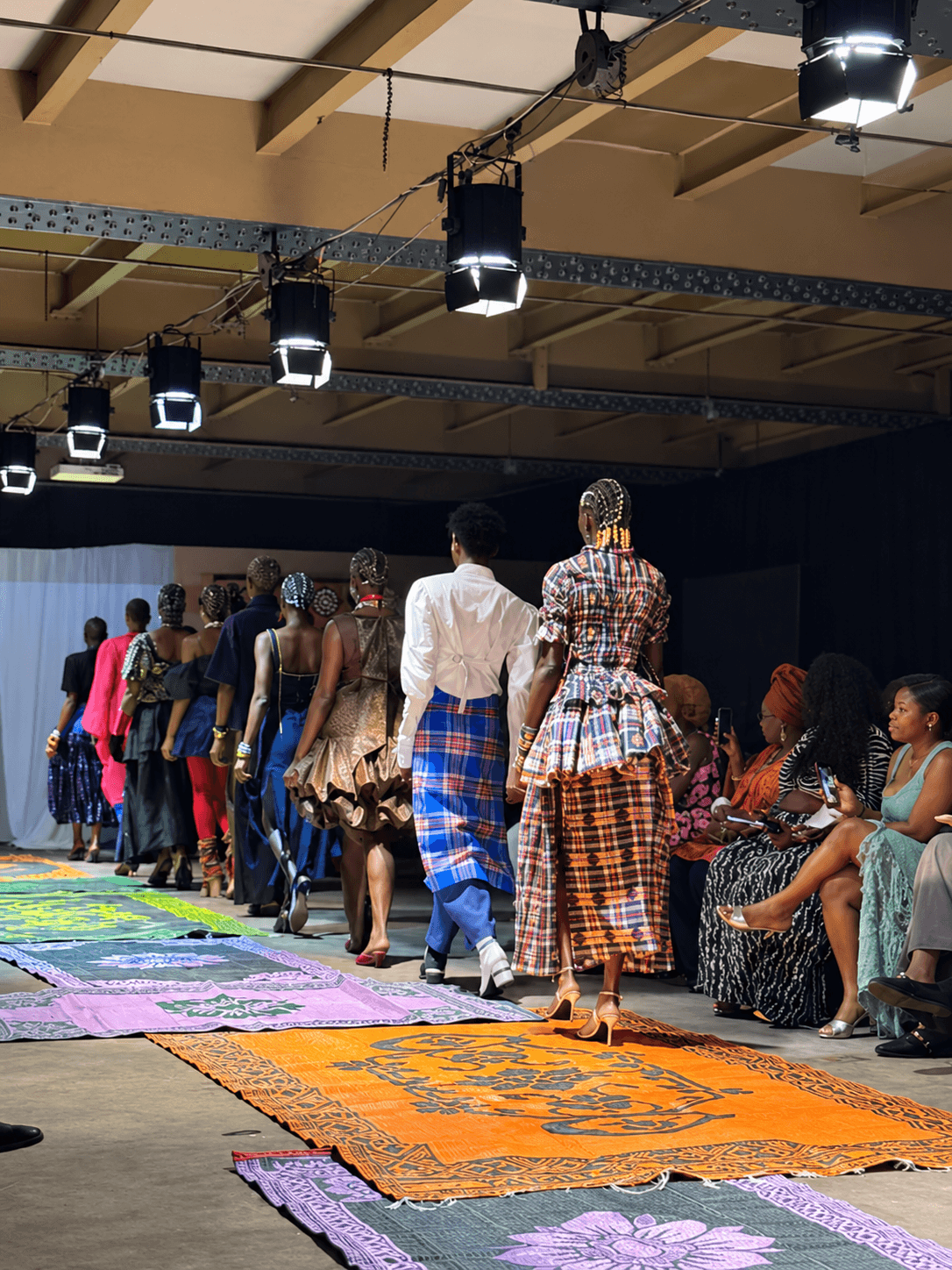
Presented on October 25 at 9 Broad Street, Lagos Island, Sisè’s EGBE URO brought Tsitse Olugbemi’s experiments with dressing into a full runway presentation. The Spring/Summer 2027 collection found much of its character in the interplay between pared-back pieces and more elaborate silhouettes.
The brand identifies Itsekiri culture as an inspiration and names George fabric and Adire among the collection’s materials. For Olugbemi, that cultural interest forms part of a broader exploration of textiles. In an interview with Marie Claire Nigeria ahead of the presentation, she described working with George and other fabrics associated with the South-South. She also traced some of her earlier textile choices to designing in Ibadan, where the influences around her helped shape the label. Her material vocabulary has developed through both personal heritage and place.
Those choices have practical dimensions, too. Adire appealed because its patterns could be reproduced consistently; Aso Oke offered rigidity and texture. The distinction gives substance to the label’s interest in African textiles: their value lies not only in their cultural associations, but also in the possibilities they offer for production and form.
Olugbemi’s approach began with her own wardrobe. “I was constantly adjusting my clothes, pinning things, adding scarves, and changing silhouettes,” she told the publication. That instinct helps explain the collection’s sense of garments still being worked on: a waist gathered, a hem interrupted, an accessory introduced to shift the emphasis.
A gathered peach top sat above loose gold-toned trousers. Pink at the neckline enlivened the warm palette, while stacked belts concentrated detail at the waist. The trousers broadened the silhouette below, falling towards heavy dark shoes. Here, the defined waist gave the outfit structure, preventing its multiple details from competing for equal attention.
A taupe top and long black skirt offered a quieter expression of the same design instinct. Gathering softened the torso, while a curved hem marked the meeting of the two colours. Against this subdued base, a chunky multicoloured necklace became the focal point. Rather than relying on elaborate construction throughout, the look showed how a single accessory could redirect attention.
Checks offered a more structural intervention. In a coordinated plaid look, a pronounced peplum projected over a long skirt. The continuous pattern linked the upper and lower sections, making the shift in shape at the hips especially clear. Here, the textile unified the look while the peplum changed its outline.
Across these looks, restraint proves as important as embellishment. The brown top gives the irregular plaid room to register; the taupe and black ensemble lets its necklace command attention. Sisè’s strongest looks understand that visual complexity depends on more than accumulation. It comes from knowing where to introduce detail, where to let a material speak, and where to leave the eye some room. In EGBE URO, Olugbemi’s interest in experimentation is most convincing when every addition has a purpose.